In Stock
Share your international phone number to discuss pricing and delivery:
Buy this product in 1 click:
Or contact us directly via:


Share your international phone number to discuss pricing and delivery:
Or contact us directly via:
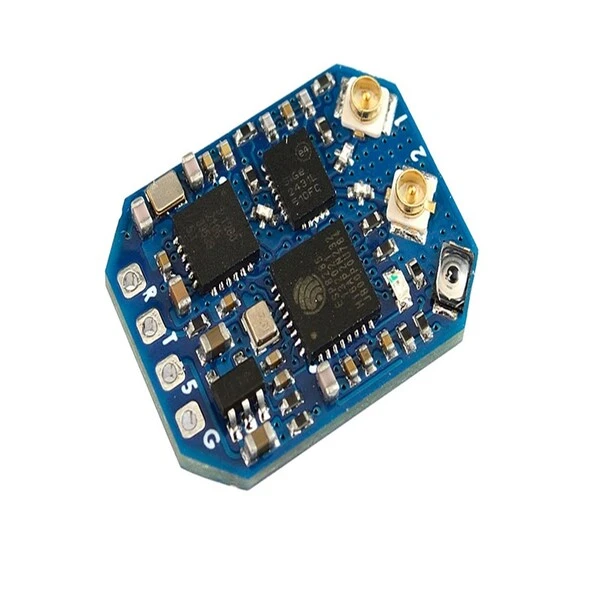
The ELRS-R24-D is a 2.4 GHz ExpressLRS receiver developed by Matek Systems. Equipped with an ESP8285 microcontroller and SX1280/1281 RF chip, it delivers high-performance, long-range, and ultra-low-latency communication. Featuring true diversity with dual external IPEX antennas, this receiver provides stable and reliable signal reception for FPV drones, fixed-wing aircraft, and UAV systems.
Table 2-1. Comparison of Matek ELRS-R24 Series Receivers
| Model | Antenna Type | Diversity | Telemetry Power | PA/LNA | Size (mm) | Weight |
|---|---|---|---|---|---|---|
| ELRS-R24-S | Built-in Ceramic | No | 20 dBm | AT2401C | 21 × 15 | 1.2 g |
| ELRS-R24-D | Dual IPEX MHF1 | Yes | 22.5–23 dBm | SE2431L | 21 × 15 | 3 g |
NOTE: When flashing firmware for R24-D, ensure “USE_DIVERSITY” is enabled in the ExpressLRS Configurator.
Table 3-1. ELRS-R24-D Technical Specifications
| Frequency Range | 2400–2480 MHz (ISM Band) |
| MCU | ESP8285 |
| RF Chip | SX1280 / SX1281 |
| Protocol | CRSF (ExpressLRS) |
| Input Voltage | 4–9 V DC |
| Telemetry Power | Up to 23 dBm |
| Power Consumption | 70 mA typical, 90 mA in WiFi mode |
| Interface | UART (TX, RX, GND, 5V) |
| Antenna Connectors | 2× IPEX MHF1 (diversity) |
| Size | 21 mm × 15 mm |
| Weight | ~3 g (with antennas) |
| Firmware Target | MATEK_2400_RX (USE_DIVERSITY = ON) |
| Pin | Name | Type | Description |
|---|---|---|---|
| 1 | 5V | Power | Power input 4–9 V DC |
| 2 | GND | Ground | Ground connection |
| 3 | TX | Output | Telemetry output / CRSF TX |
| 4 | RX | Input | CRSF RX |
| 5 | BOOT | Input | Firmware flashing mode |
| Operating Temperature | -20 °C ~ +85 °C |
| Storage Temperature | -40 °C ~ +90 °C |
| Shock Resistance | 25 g / 11 ms / 3 axes |
There are no reviews for this product.
There are no reviews for this product, be the first to leave your review.
No questions about this product, be the first and ask your question.